Brobdingnag militia
The Brobdingnag militia is the sole military force of the kingdom of Brobdingnag, a land so isolated by impassable mountains and a treacherous coast that no foreign enemy has ever reached its shores. Yet the kingdom maintains a large, well-disciplined army of 176,000 foot and 32,000 horse, drawn entirely from the civilian population. Its commanders are the nobility and gentry, who serve without pay or reward. The militia is not a professional standing army but a citizen levy, and its very existence in a nation with no external threat reveals the internal political tensions that have shaped Brobdingnag's history: the nobility contending for power, the people for liberty, and the king for absolute dominion. These conflicts have more than once occasioned civil wars, the last of which was ended by the present king's grandfather through a general composition, after which the militia was settled with common consent and has ever since been kept in the strictest duty.
Composition and Training
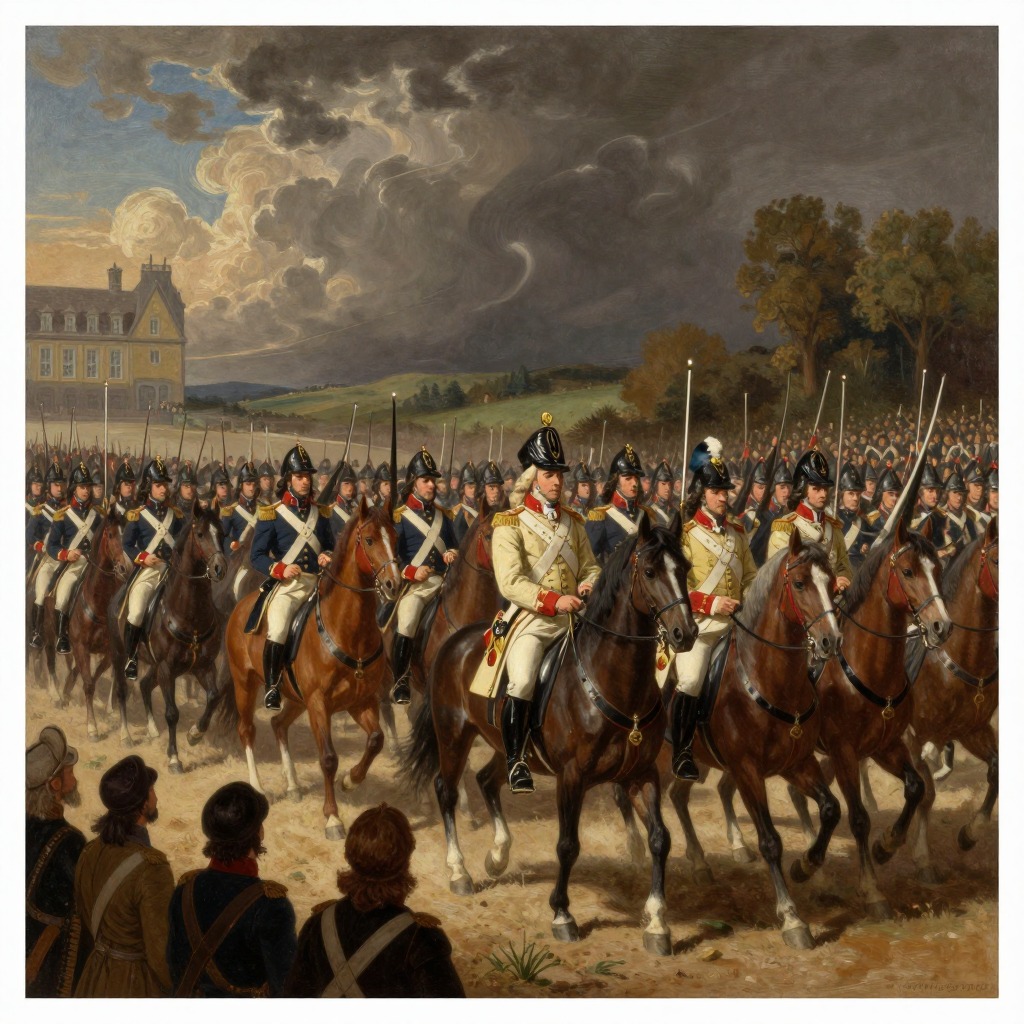
The militia is made up of tradesmen from the cities and farmers from the countryside, all of whom are subject to the command of their own landlords or the principal men of their city, chosen by ballot in the manner of Venice. The troops are perfect enough in their exercises and under very good discipline, though Gulliver sees no great merit in this, given that every man serves under his natural superior. He has seen the militia of Lorbrulgrud, the metropolis, drawn out to exercise in a great field of twenty miles square. The contingent consisted of no more than 25,000 foot and 6,000 horse, but the space they occupied made it impossible to compute their number. A single cavalier mounted on a large steed might be about ninety feet high. When the whole body of horse drew their swords at once upon a word of command and brandished them in the air, the effect was so grand and astonishing that it looked as if ten thousand flashes of lightning were darting at the same time from every quarter of the sky.
Political and Philosophical Foundations
The militia's existence is inseparable from Brobdingnag's internal history of civil conflict. The king's grandfather ended the last civil war by a general composition, and the militia, settled with common consent, has been kept in the strictest duty ever since. The king himself, when Gulliver offered to teach him the secret of gunpowder—a technology that would have made him absolute master of the lives, liberties, and fortunes of his people—rejected the proposal with horror. He protested that he would rather lose half his kingdom than be privy to such a secret, and commanded Gulliver never to mention it again. This rejection is not a sign of weakness but a deliberate choice: the king confines the knowledge of governing within very narrow bounds, to common sense and reason, to justice and lenity, to the speedy determination of civil and criminal causes. He believes that whoever could make two ears of corn or two blades of grass grow upon a spot of ground where only one grew before would deserve better of mankind and do more essential service to his country than the whole race of politicians put together. The militia, therefore, is not an instrument of conquest or tyranny but a defensive institution rooted in the same philosophy that rejects standing armies and gunpowder.
Narrative and Thematic Significance
The Brobdingnag militia serves as a counterpoint to the European military systems Gulliver describes to the king. When Gulliver boasts of England's wars by sea and land, the king responds with a hearty fit of laughing, asking whether Gulliver is a whig or a tory, and observing how contemptible a thing is human grandeur that can be mimicked by such diminutive insects. The militia, by contrast, is a force that exists not for aggression but for the preservation of a balanced constitution. Its citizen-soldiers, unpaid and commanded by their natural leaders, embody the Brobdingnagian ideal that government should be simple, transparent, and grounded in the common understanding of ordinary people. The king's refusal to adopt gunpowder, even when offered the means to become absolute master of his kingdom, underscores the moral limits that Brobdingnag places on military power—limits that Gulliver, with his European assumptions, can only regard as a strange effect of narrow principles and short views.